Power Electronics | Wide-Bandgap (SiC/GaN) | CLLC & Dual Active Bridge (DAB) | AI Data Centers | EV Powertrain | Renewable & Grid Integration | Energy Transition | Hyper-Scaling Innovation | Independent Advisor
June 4, 2025
As global energy systems evolve toward greater decentralization, bi-directionality, and electrification, conventional low-frequency transformers are reaching their performance and integration limits. Enter Solid-State Transformers (SSTs) – compact, controllable, and capable of interfacing AC and DC domains across multiple voltage levels and frequencies.
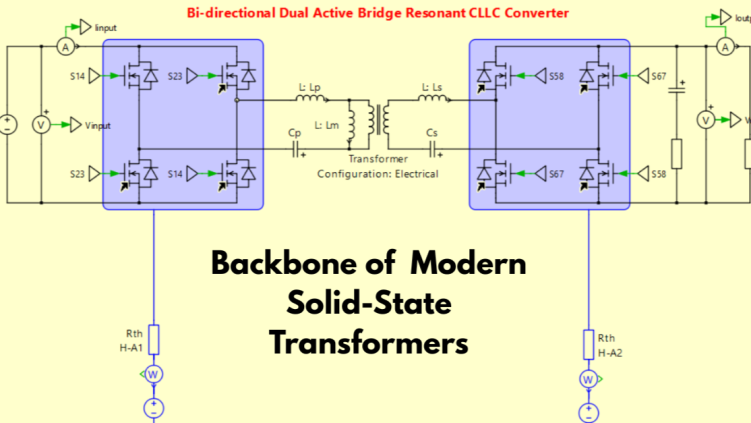
At the heart of this transformation lies a high-efficiency, bidirectional, and high-frequency DC-DC converter topology: The Bidirectional Resonant CLLC Converter.
What is a CLLC Resonant Converter?
The CLLC topology refers to a Capacitor–Inductor–Inductor–Capacitor resonant tank embedded in a dual active bridge (DAB) configuration. Both primary and secondary sides are full-bridge converters connected via a high-frequency transformer. Both bridges can operate in inverter or rectifier mode, enabling true bidirectional power flow.
What makes the CLLC stand out is its ability to:
- Support bidirectional power flow (source-to-load and load-to-source),
- Maintain ZVS/ZCS (soft-switching) across wide voltage and load ranges,
- Operate efficiently at high switching frequencies (>200 kHz),
- Suitability for wide voltage range regulation via frequency modulation,
- Integrate easily with SiC/GaN switches to minimize losses,
- Shrink magnetic size, improving power density and thermal performance.
Why It Matters for SSTs
Modern SSTs are often three-stage systems:
- MVAC to MVDC via multilevel converters,
- MVDC to LVDC via bidirectional CLLC resonant converter, and
- LVDC to LVAC via inverter.
The second stage – MVDC to LVDC – demands a high-efficiency, isolated, bidirectional DC-DC converter. This is where the CLLC converter excels, offering:
- Wide input/output voltage handling,
- Galvanic isolation,
- Low EMI,
- Soft switching under most conditions, reducing losses and stress.
The bidirectional mode enables Vehicle-to-Grid (V2G), battery storage systems, and DC microgrid integration.
Deep Dive: Operating and Control Principles
Unlike traditional hard-switched converters or even non-resonant Dual Active Bridge (DAB) topologies that use phase-shift control, the CLLC converter relies on frequency modulation (FM) to control its output power and voltage.
How It Works:
The gain of the converter varies with switching frequency:
- At resonant frequency: Gain ≈ 1
- Below resonance: Gain > 1 (Boost mode)
- Above resonance: Gain < 1 (Buck mode)
Output regulation is achieved by shifting the frequency up or down, while maintaining zero-voltage (ZVS) and zero-current switching (ZCS) across a wide range.
This makes the CLLC ideal for dynamic voltage environments like DC grids, battery systems, and renewable energy interfaces.
High Frequency = High Power Density
The ability to operate at hundreds of kilohertz significantly reduces the size of magnetic components, filters, and heatsinks. This means:
- Smaller SST footprint
- Lower cooling demand
- Better modularity for containerized or rack-mounted systems
In a world where size, efficiency, and thermal management are tightly coupled, the CLLC enables lightweight, scalable SST solutions.
Outlook: CLLC as the Dominant DC-DC Topology in SSTs?
Given its efficiency, flexibility, and performance, the resonant CLLC converter is quickly becoming the default choice for the DC-DC stage in Solid-State Transformers.
Other topologies – such as hard-switched DABs, LLC, or SRC – each have niche uses, but none offer the same balance of:
- Bi-directionality
- Wide voltage regulation
- Soft switching
- Compactness
As grid systems demand more controllable, scalable power conversion, expect the CLLC converter to play a pivotal role in shaping SST architectures for electric utilities, mobility, and industrial electrification.
#PowerElectronics #CLLC #SolidStateTransformer #SmartGrid #SiC #GaN #EnergyStorage #BidirectionalPower #ElectricGrid #DigitalTransformer