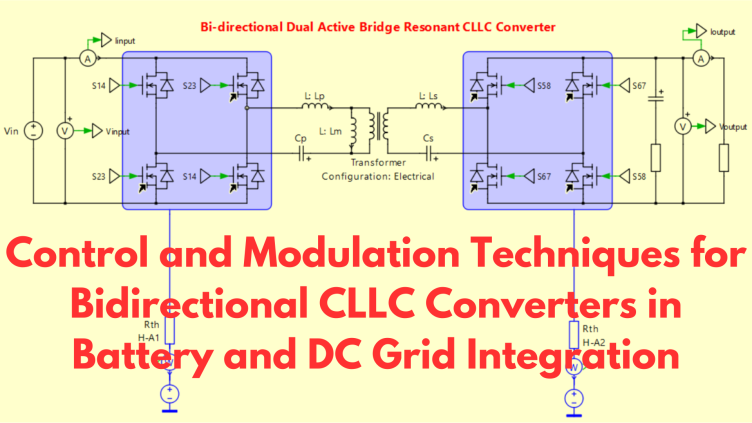
As EV fast charging, battery energy storage systems (BESS), and DC grid applications expand, bidirectional isolated DC-DC converters are playing a central role in enabling flexible, efficient power flow.
Among available topologies, the CLLC resonant converter has become a preferred choice due to its soft-switching behavior, high efficiency, and symmetric bidirectional operation.
However, achieving stable and efficient power transfer in real-world systems requires advanced digital control and modulation techniques, especially when converters must operate across wide input and output voltage ranges.
1) Understanding Gain Characteristics in CLLC
The CLLC converter uses a resonant network with two inductors and two capacitors, providing symmetrical gain behavior for forward and reverse power flow.
- The gain curve depends on the ratio of switching frequency to resonant frequency.
- Proper frequency modulation (FM) allows smooth power transfer across varying battery voltages and DC bus conditions.
- Unlike fixed-frequency topologies, CLLC operation must be carefully tuned to maintain ZVS for primary switches and ZCS for secondary rectifiers.
2) Digital Control Strategies
Modern digital controllers enable sophisticated control algorithms for bidirectional CLLC converters:
- Frequency Modulation (FM): Varying the switching frequency to control gain while maintaining soft switching.
- Phase-Shift Modulation (PSM): Used in combination with FM for finer power control.
- Adaptive Gain Control: Adjusts control parameters dynamically as battery voltage or DC bus voltage changes.
- Current Sharing for Paralleled Modules: Essential when scaling with multiple 30–50 kW converter blocks to reach 150-300 kW systems.
3) Wide Voltage Variation Operation
EV batteries and grid-connected storage systems experience significant voltage fluctuations:
- EV batteries: 200-450 V (400 V systems) or 400-900 V (800 V systems).
Control schemes must:
- Maintain soft switching across this wide voltage window.
- Ensure stable bidirectional power flow during charging and discharging.
- Prevent circulating currents when multiple modules are paralleled.
Digital control also enables fault handling, grid support modes, and dynamic response for DC grid integration.
4) Future Trends
With SiC MOSFETs pushing switching frequencies beyond 100 kHz, high-speed digital controllers are becoming essential.
Next-gen solutions will integrate:
- Model-based control for optimal efficiency.
- Real-time adaptive tuning of resonant parameters.
- Communication-enabled current balancing for large-scale modular systems.
Final Thought
Bidirectional CLLC converters, when combined with advanced digital control and modulation techniques, provide a scalable and efficient solution for EV charging infrastructure and DC grid integration.
The key to success lies in precise gain control, adaptive operation across wide voltage ranges, and stable paralleling strategies, all enabled by high-performance digital controllers.
What control strategies have you found most effective for bidirectional resonant converters?