#AI #DataCenters #OpenCompute #HVDC #PowerElectronics #SiC #GaN #SSCB #OCP #AIInfrastructure
AI is rewriting the rules of compute infrastructure and power delivery is now at the heart of the transformation.
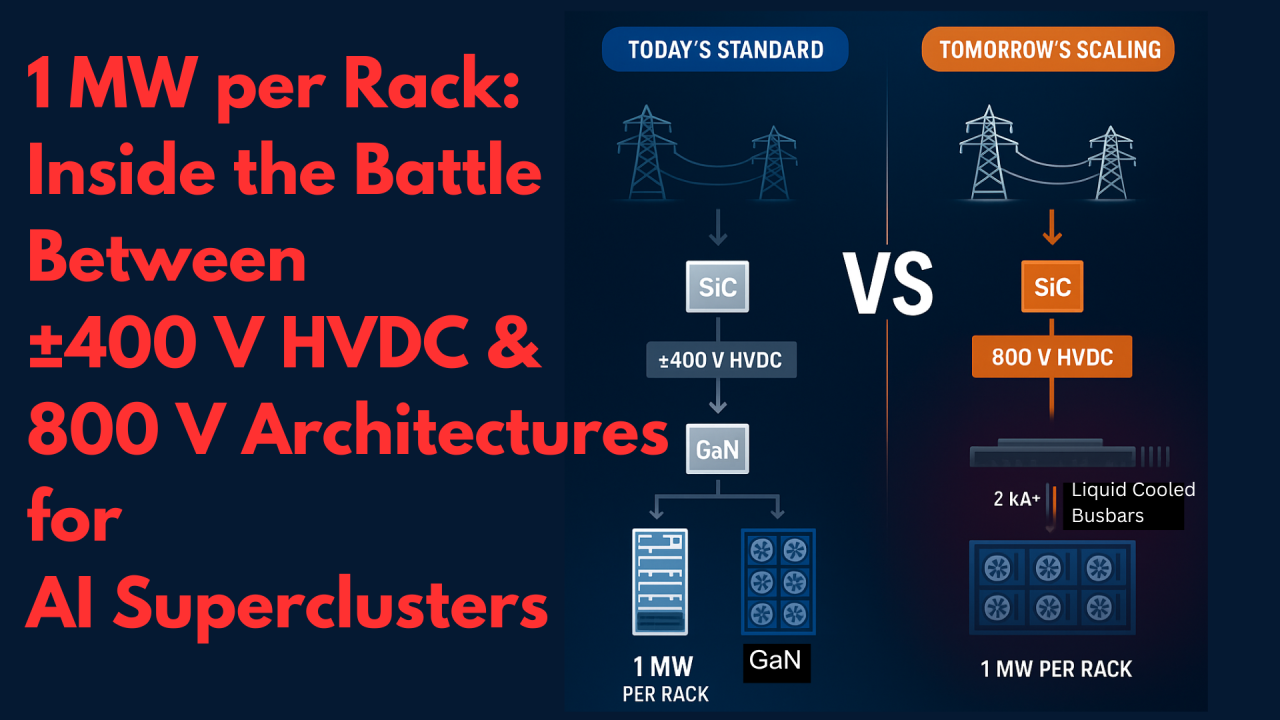
With GPU-dense AI racks drawing 800 kW to 1.1 MW today and pushing toward 1.5 MW+, the traditional 48 V DC power model is hitting a hard ceiling. To keep up, the industry is moving toward high-voltage DC (HVDC) fabrics: first at ±400 V with OCP’s Diablo 400 architecture, and soon at 800 V HVDC, as envisioned by NVIDIA, Vertiv, and other hyperscalers.
Why 48 V Power Fabrics Are No Longer Enough
For years, 48 V DC distribution was the standard for hyperscale data centers. It worked well when racks consumed 10 kW to 30 kW, but AI workloads changed everything:
- Megawatt-class racks → AI training clusters can demand 1.1 MW per rack today.
- Extreme currents → Scaling 48 V to megawatts would require massive copper busbars and heavy cabling.
- I²R losses and thermal stress → Significant energy wasted as heat, driving up cooling costs.
- Complexity → Multiple AC-DC-DC conversion stages lower overall efficiency and increase failure points.
It became clear: power fabrics need a higher voltage backbone.
±400 V HVDC: Today’s Solution for AI Racks
Enter the Open Compute Project (OCP) Diablo 400 specification, co-authored by Microsoft, Meta, and Google, which defines a disaggregated power architecture delivering ±400 V HVDC directly to racks.
Power Flow: Grid AC → SiC-based Solid-State Transformer → ±400 V HVDC Bus → GaN-based Isolated DC-DC → ASICs / GPUs
Key Advantages of ±400 V HVDC
- Scalability → Supports 800 kW to 1.1 MW per rack.
- Efficiency → >98% efficiency at 50% load, reducing power loss and cooling needs.
- Modularity → Disaggregated power racks (“sidecars”) centralize conversion, letting IT racks evolve independently.
- Standardization → OCP’s open design encourages ecosystem alignment across connectors, busbars, and telemetry.
Diablo 400 solves today’s AI power challenges — but as compute density accelerates, even ±400 V begins to hit its limits.
The Rise of 800 V HVDC Fabrics
Hyperscalers and infrastructure providers like NVIDIA and Vertiv are already prototyping 800 V HVDC fabrics to power next-generation AI superclusters.
Why 800 V Is the Future
- Lower current for the same power → Halves conductor sizes and reduces copper weight.
- Supports 1.5 MW+ racks → Essential as GPU counts per rack continue climbing.
- Improves cooling → Less I²R loss reduces thermal hotspots, enabling liquid-cooled busbars.
- Simplifies conversion stages → High-voltage DC distribution enables fewer AC/DC and DC/DC transitions.
Engineering Changes Needed
Transitioning from ±400 V HVDC to 800 V HVDC isn’t just about increasing voltage, it requires architectural and technological shifts:
1. Solid-State Transformers (SiC)
- Replace bulky low-frequency transformers.
- Enable high-voltage AC/DC conversion at multi-megawatt scales.
- Integrated telemetry improves monitoring and predictive maintenance.
2. Busbar & Connector Design
- Liquid-cooled busbars capable of handling 2 kA+ continuous current.
- Arc-resistant connectors and hot-swappable PSU designs rated for higher voltages.
3. Rack Safety Protocols
- Solid-State Circuit Breakers (SSCBs) for microsecond fault isolation.
- Ground fault detection integrated into power fabrics.
- Enhanced arc-flash protection for operators.
Diablo 400: The Bridge to 800 V AI Factories
The OCP Diablo 400 spec isn’t the endgame, it’s the foundation. By standardizing:
- ±400 V busbars and connectors
- Hot-swappable PSUs up to 30 kW
- Integrated telemetry (Redfish, CAN, PMBus)
- Safety and grounding models
…Diablo 400 establishes the design language for the 800 V standards of tomorrow.
Key Takeaways
- 48 V is obsolete for AI racks — it can’t scale to megawatt levels.
- ±400 V HVDC (Diablo 400) is the current baseline, enabling 1.1 MW per rack with high efficiency.
- 800 V HVDC fabrics are coming — they’ll halve currents, enable liquid-cooled power fabrics, and support AI factories at scale.
- Wide-bandgap devices (SiC & GaN) are the cornerstones enabling this transition.
AI isn’t just changing compute, it’s rewriting data center power architectures. The move from 48 V → ±400 V → 800 V HVDC marks a generational shift in how we feed the GPUs driving the AI revolution.
Delivering high-performance power electronics solutions often requires targeted expertise and scalable engineering resources.Whether it’s SiC/GaN-based designs, thermal optimization, or system-level integration, I’m open to connecting and exploring how a results-focused engineering partnership can help your team hit key milestones faster.