Power Electronics | Wide-Bandgap (SiC/GaN) | CLLC & Dual Active Bridge (DAB) | AI Data Centers | EV Powertrain | Renewable & Grid Integration | Energy Transition | Hyper-Scaling Innovation | Independent Advisor
June 3, 2025
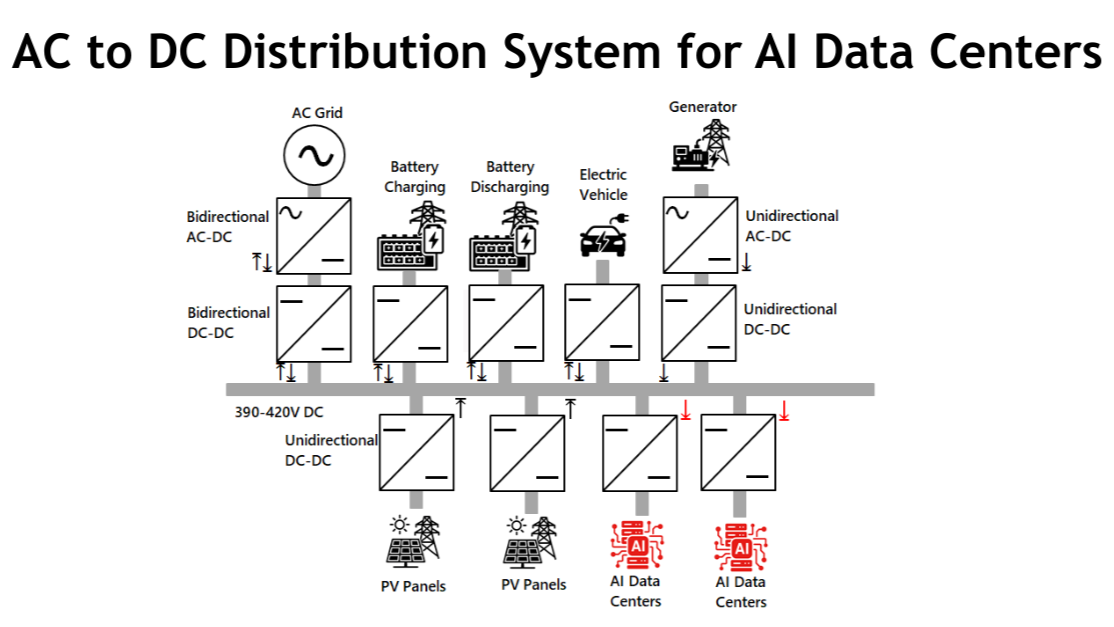
AI data centers are undergoing a seismic shift: from AC to DC distribution. Why? Up to 15% energy savings, 20% less downtime, and seamless integration with renewables. But challenges remain – standardization, retrofitting, and more. Dive into my latest article to explore how this transition powers the future of AI, from NVIDIA’s 800V architectures to Google’s 48V racks.
Why the Shift from AC to DC Distribution in AI Data Centers?
- Efficiency Gains Due to Fewer Power Conversions: Traditional AC distribution systems in data centers involve multiple AC-to-DC and DC-to-AC conversions (e.g., from grid AC to UPS, battery storage, and server-level DC). Each conversion incurs losses (typically 5–10% per stage). DC distribution reduces these steps by delivering DC power directly to servers, which internally operate on DC. This can save up to 10–15% in energy, as noted in demonstrations by Lawrence Berkeley National Laboratory.
- High Power Density for AI Workloads: AI data centers are seeing rack power densities increase from 20 kW to 80–200 kW due to GPU and TPU demands. For example, NVIDIA’s H100 accelerator has a 700 W TDP, and next-gen models like Blackwell B200 may reach 1200 W. DC systems, especially at higher voltages like 48V or ±400V, reduce current levels and resistive losses enabling efficient power delivery to these high-density racks.
- Reduced Cooling Needs: DC systems generate less heat due to fewer conversion losses, reducing the cooling load. This is critical for AI data centers, where cooling can consume as much power as IT equipment. Liquid cooling pairs well with DC distribution can also cool high-current busbars reducing their size by up to 5X.
- Integration with Renewables and Storage: DC systems simplify integration with renewable energy sources (e.g., solar, fuel cells) and battery storage, which output DC natively. This avoids additional AC-DC conversions, improving efficiency and supporting sustainability goals.
- Simplified Infrastructure and Reliability: DC systems use fewer components (no transformers or rectifiers at the rack level), reducing points of failure and improving reliability. They also eliminate AC-specific issues like harmonics and phase balancing.
- Grid Resilience for Uninterrupted AI Workloads: DC distribution enhances grid resilience, a critical factor for AI data centers requiring 99.999% uptime. By eliminating AC-to-DC conversion losses during outages, DC systems ensure faster, more reliable transitions to backup power—reducing downtime by up to 20%, per Schneider Electric. They also decouple the data center from grid frequency; enabling independent operation with on-site DC sources like solar. Additionally, DC systems use solid-state circuit breakers with response times under 100 µs, enabling rapid fault isolation compared to AC’s slower mechanical breakers.
- Industry Trends and Adoption: Major players like Google, Facebook, and NVIDIA are adopting DC distribution. Google’s 48V rack solution and the Open Compute Project’s work on DC standards are examples. Recent posts on X highlight NVIDIA and Infineon collaborating on 800V DC architectures for AI data centers, and Microsoft, Google, and Meta adopting 400V DC systems inspired by EV technology.
Challenges and Considerations
While DC distribution is gaining traction, challenges remain:
- Standardization: DC systems lack universal voltage and connector standards, unlike AC’s established 480V/208V norms.
- Infrastructure Compatibility: Most existing data centers are AC-based, requiring retrofits or new builds for DC. Retrofitting for AI workloads is complex but feasible.
- Equipment Availability: DC-compatible infrastructure is limited, though growing.
Despite these, the efficiency, density, and sustainability benefits make DC the preferred choice for new AI data centers.
#AIDataCenters #PowerElectronics #Sustainability #Innovation