Power Electronics | Wide-Bandgap (SiC/GaN) | CLLC & Dual Active Bridge (DAB) | AI Data Centers | EV Powertrain | Renewable & Grid Integration | Energy Transition | Hyper-Scaling Innovation | Independent Advisor
June 18, 2025
#PowerElectronics #WideBandgap #SiC #GaN #DCtoDC #ResonantConverters #BidirectionalPower #CLLC #DualActiveBridge #ZVS #HighFrequencyPower
1. Where DAB-CLLC Fits in the Power Electronics Landscape
In modern power conversion – especially in high-density, bidirectional, isolated DC-DC applications-the Dual Active Bridge (DAB) combined with Resonant CLLC topology is increasingly preferred. Whether in battery chargers, energy storage systems, or AI data center racks, this topology offers:
- Bidirectional power flow
- Galvanic isolation
- Soft switching capability
- Scalability across voltage and power levels
But the full potential of this topology is unlocked only when paired with Wide Bandgap (WBG) devices like Silicon Carbide (SiC) and Gallium Nitride (GaN).
2. Topology Overview
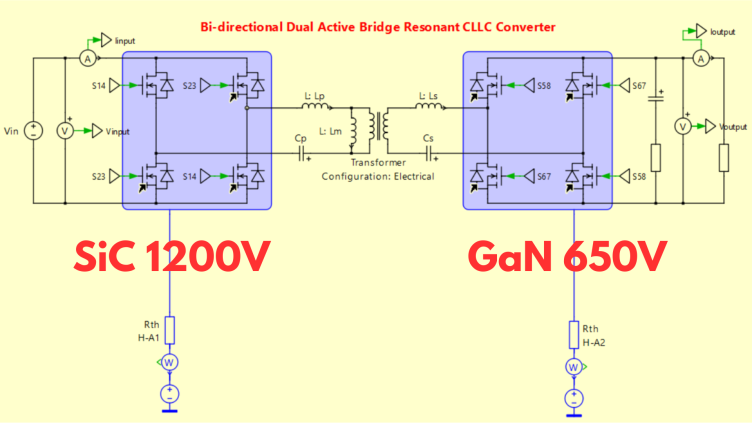
Topology for DAB Bidirectional Resonant CLLC
A single-line diagram illustrates:
- Two full-bridges (primary and secondary), each using SiC/GaN switches.
- A CLLC resonant tank between them (Cp-Lp-Lm-Cs).
- A high-frequency transformer providing isolation and voltage scaling.
- Bidirectional flow achieved through frequency modulation control.
This topology supports:
- DC to DC conversion across wide voltage ranges
- Soft-switching (ZVS/ZCS) under correct control
- Symmetrical operation for charging/discharging modes
3. ZVS/ZCS Dependency: Why Soft-Switching Matters in Both Directions
In high-frequency converters, switching losses dominate. Zero Voltage Switching (ZVS) and Zero Current Switching (ZCS) reduce:
- Turn-on and Turn-off switching losses
- EMI from abrupt transitions
- Stress on MOSFETs and transformer windings
Bidirectional operation makes it more challenging:
- Power flows in both directions dictates resonant tank behavior change
- ZVS must be guaranteed in all four quadrants (+/-Vin, +/-Iout)
- Light-load and reverse-mode ZVS are difficult with silicon
Soft-switching performance is thus not optional, but essential.
4. WBG to the Rescue: Device Level Traits That Map to CLLC Needs
SiC and GaN devices directly address the ZVS/ZCS needs:
This enables MHz-class converters, small magnetics, and better dynamic response in fast-charging or grid-tied systems.
5. Application Examples – G2V Charging, SST, AI Rack Power
a) EV Battery (G2V and V2G) Charging Bidirectional flow between two EVs or between vehicle and grid. DAB-CLLC with SiC enables compact, air-cooled, isolated designs.
b) Solid-State Transformers (SSTs) Replace bulky line-frequency transformers. DAB-CLLC enables HV to LV conversion with high efficiency and fast control response.
c) 48V AI Rack Power Systems High-power computing racks (e.g., GPUs, TPUs) demand low-voltage, high-current delivery. GaN-powered DAB-CLLC allows high density and soft switching at 1 MHz.
6. Challenges with Si/IGBT – Switching Loss, Dead-Time, Reverse Recovery
Silicon devices (MOSFETs or IGBTs) introduce major limitations:
In bidirectional converters, these issues are amplified since both legs must operate with tight timing and fast transitions.
7. WBG + CLLC Is the Future of High-Performance DC-DC
The synergy between resonant bidirectional topologies and WBG semiconductors is not just beneficial – it’s inevitable for:
- Efficiency beyond 98%
- Compact, scalable converter modules
- High reliability across full bidirectional load range
As electrification and AI data center infrastructure accelerate, DAB Resonant CLLC with SiC/GaN is poised to be the foundational architecture of next-gen power delivery.