Power Electronics | Wide-Bandgap (SiC/GaN) | CLLC & Dual Active Bridge (DAB) | AI Data Centers | EV Powertrain | Renewable & Grid Integration | Energy Transition | Hyper-Scaling Innovation | Independent Advisor
July 9, 2025
#PowerElectronics #ZVS #ZCS #CLLC #DAB #SoftSwitching #SiC #GaN #SolidStateTransformer #EVCharging #DigitalPower #ResonantConverter
As power converters evolve to operate achieving soft switching, operating them at ever-higher frequencies helps reducing the magnetics volume and along with reduced total cooling requirements.
Two common soft-switching techniques are:
- ZVS (Zero Voltage Switching)
- ZCS (Zero Current Switching)
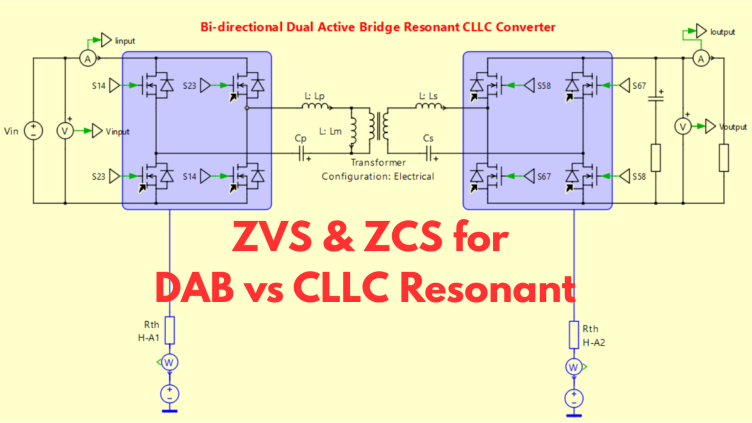
Though often mentioned together, ZVS and ZCS are fundamentally different, and their relevance varies across converter topologies – especially in Dual Active Bridge (DAB) and Resonant CLLC converters.
This post clarifies where and why each matters and how they impact converter design in Solid-State Transformers, EV fast chargers, and DC grids.
What is ZVS?
In Zero Voltage Switching, the voltage across a switch is reduced to near-zero before turning it on. This eliminates switching losses – especially critical for fast SiC/GaN switches.
- Goal: Avoid turning on the switch when voltage is high
- Reduces: Switching loss + EMI
- Common in: DAB converters, especially for turn-on events
What is ZCS?
In Zero Current Switching, the switch turns off when the current through it naturally reaches zero. This avoids inductive turn-off stress and mitigates diode reverse recovery issues.
- Goal: Avoid turning off the switch while current is high
- Reduces: Device stress + losses during turn-off
- Common in: Resonant converters like LLC and CLLC
ZVS in Dual Active Bridge (DAB)
The DAB topology uses two full-bridges connected via a high-frequency transformer; often uses phase shift control to regulate power flow. ZVS is typically achieved on the primary side switches when the load current is sufficient.
But there’s a caveat:
- At light loads, ZVS can fail, leading to hard switching.
- Control strategies may introduce dead times or clamp circuits to recover soft switching at partial loads.
ZVS is the dominant soft switching mechanism in DAB systems but ZCS is usually not achieved due to hard current commutation.
ZVS & ZCS in Resonant CLLC Converters
CLLC converters use a resonant tank (C-L-L-C) between two active bridges, and frequency modulation for control and not phase shift.
The resonance enables sinusoidal current waveforms, which:
- Naturally bring voltage to zero before switching (ZVS)
- Cause current to cross zero smoothly (ZCS)
Result: CLLC can achieve both ZVS and ZCS across a wide range Benefit: High efficiency, reduced EMI, and lower thermal stress Advantage: Better soft switching even at light or variable loads
This makes the resonant CLLC topology particularly well-suited for bidirectional power transfer, where load conditions change rapidly (e.g., V2G, solar inverters, battery inverters).
Side-by-Side Comparison
Why This Matters in Modern Power Systems
Whether you’re designing converters for:
- Solid-State Transformers in MV grid applications
- EV fast chargers with bidirectional flow
- Battery energy storage interfaces
- Industrial DC buses or microgrids
… achieving reliable soft switching across all operating points is crucial for efficiency, longevity, and safety.
The Resonant CLLC converter, with its inherent ZVS and ZCS characteristics, is emerging as the backbone topology for many of these applications.
Final Thoughts
If you’re working on high-frequency, bidirectional, or compact power converters, understanding how ZVS and ZCS work and how they’re implemented differently in DAB vs. CLLC can lead to better thermal design, lower switching losses, and improved system reliability.